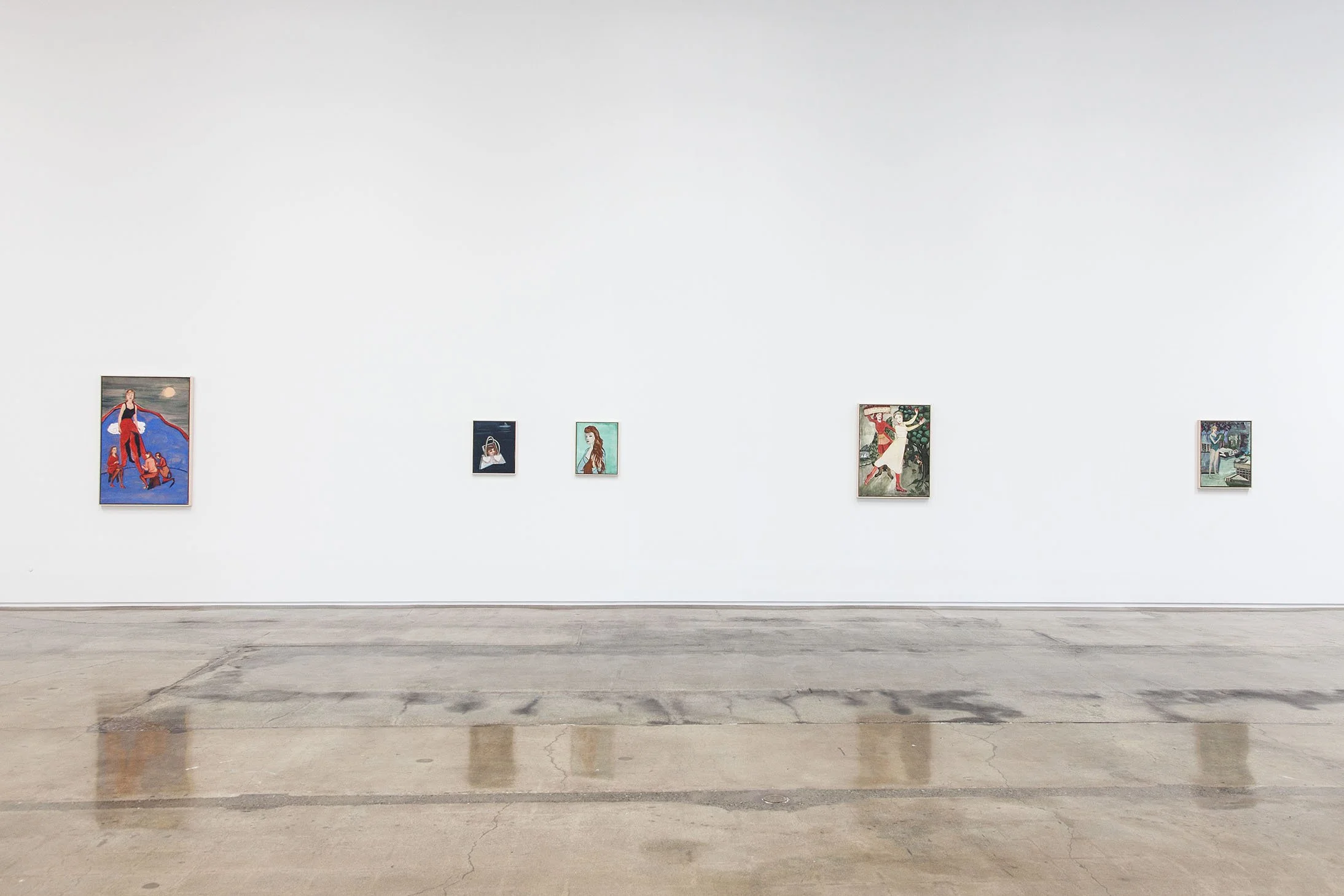
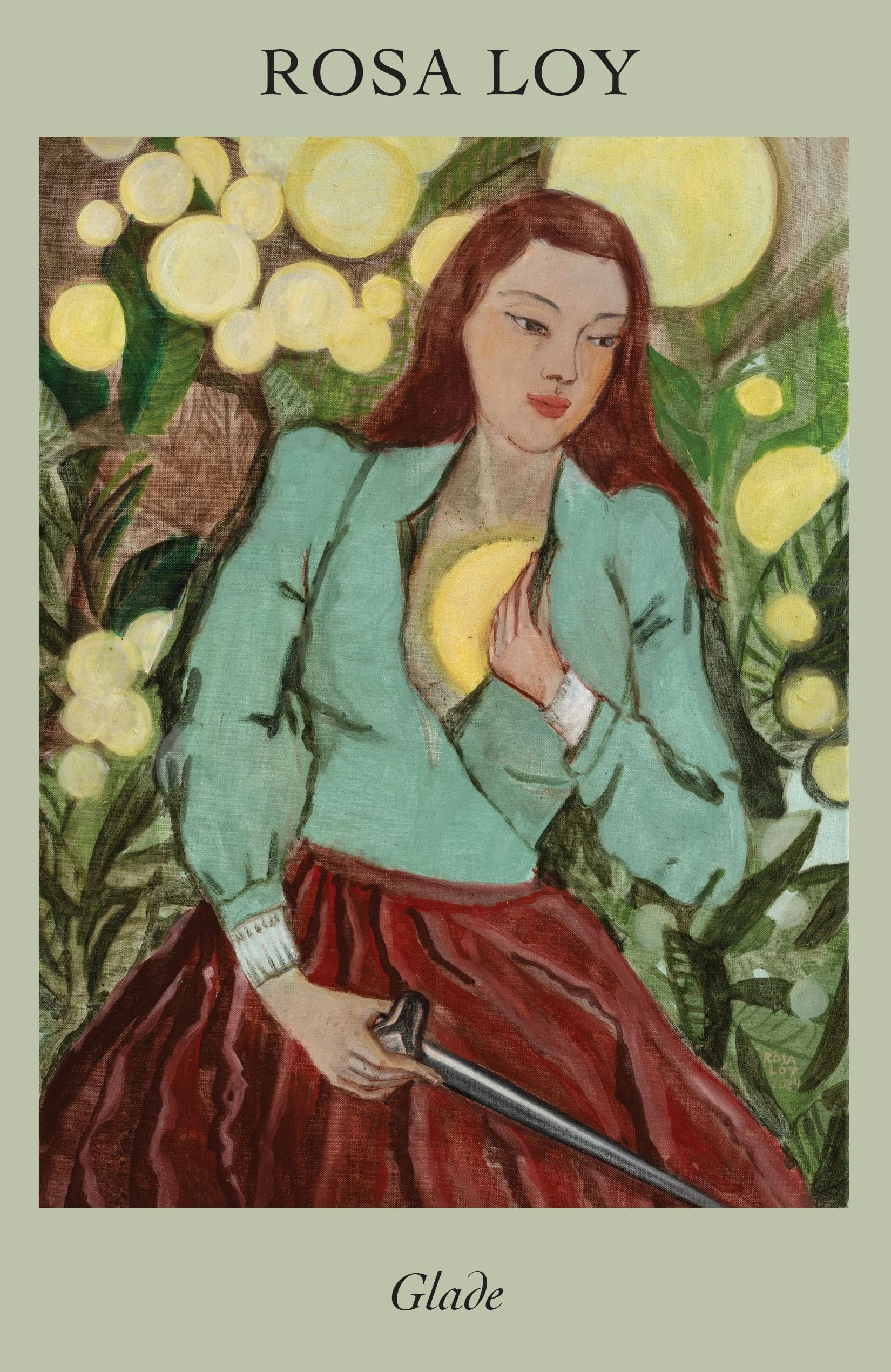
Rosa Loy
Rosa Loy can thus be seen as one of those who participate in weaving the precious magic curtain that drifts through the epochs, in the shadow of which monsters surely also nest, but whose touch always has a healing effect. In the process, she pursues the great mysteries, seeing herself involved in circles where lost female knowledge circulates and is rekindled. And whoever delivers himself up to her pictures with an alert mind can sense their inherent vitality overflow onto himself.
— Riese, Rauch, & Steiner
Selected Works
Exhibitions
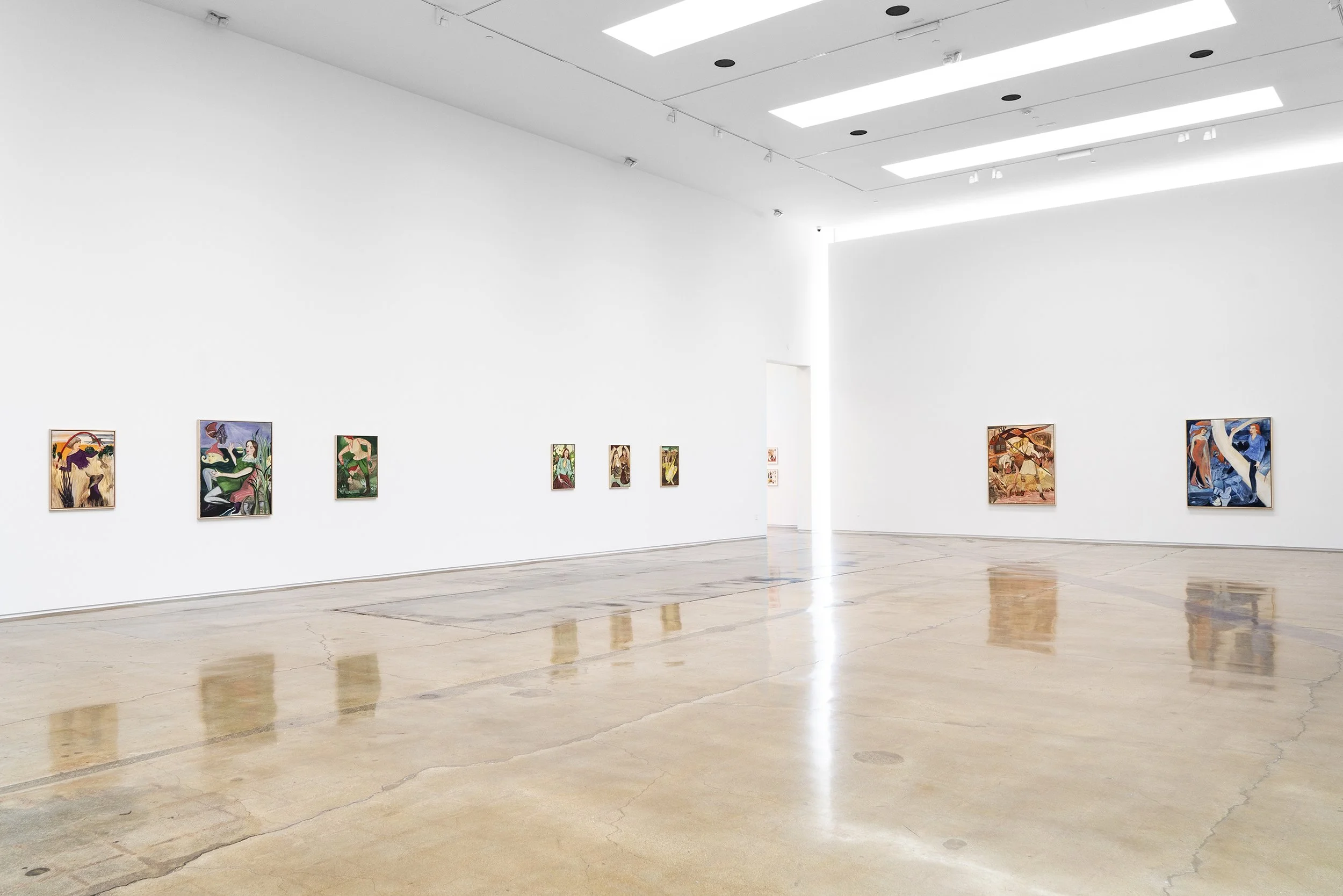
Selected Press
Every day artist Rosa Loy rides her bicycle 10 kilometers through Leipzig from her home to the studio she has kept since 1994. “My mind clears of everything I’ve been thinking of at home,” she said during a recent conversation. “I go into the studio, have a tea, start to paint, and see what’s coming in. I wait for a tingling feeling like someone is watching me from behind. That’s where my ideas come from.”
Like vivid flowers blooming out of damp soil and bright eyes emerging from dark wombs, German artist Rosa Loy has trekked deep through the trails of her own subconscious, lush with shaded verdure, and come to a restful pitstop within lichtung, a word she describes as “the place in the middle of a dark forest where the sun is shining.”
In Leipzig-based painter Rosa Loy’s phantasmagoric compositions, the industrious, rosy-cheeked women of socialist realism are recast in Kafkaesque mise-en-scènes, in which they farm human-faced heads of lettuce, feed lollipops to Harpies wearing headbands, and recline on couches in poses of analysands more than odalisques.
Propaganda and art are often thought of as opposites: The former rehashing cliches to serve the powers that be, and the latter inspiring individuals to believe they are in the presence of something special — a unique human expression, unlike anything else in the world.
The women in Rosa Loy’s dreamlike figurative paintings have always been engaged in something significant: just don’t ask the artist what it all means. In a new show at Kohn Gallery in Los Angeles, the member of the so-called New Leipzig School is happy for her paintings to lead to a little confusion. Words by Katya Tylevich
Yuval Sharon, founder and director of LA’s The Industry, Broad collection artist Neo Rauch and painter Rosa Loy will discuss their production of Richard Wagner’s “Lohengrin” at the 2018 Bayreuth Festival, which – according to The New York Times – “made Wagner a feminist.”
AYREUTH, Germany — In the 142 years since Richard Wagner made front-page news in New York with the first Bayreuth Festival, Americans have sung here, conducted here, made countless pilgrimages up a little green hill to sit, sweltering, in the temple that the composer built to his own art. But until now, no American had been entrusted with a production.
This summer, some of Germany’s most noted artists are lending their talents to two high-profile productions at prestigious music festivals. In late June, Georg Baselitz furnished somber and mournful sets for Pierre Audi’s production of “Parsifal” at the Munich Opera Festival. Meanwhile, in Bayreuth, the husband-and-wife artist duo, Neo Rauch and Rosa Loy, are working on the new “Lohengrin” overseen by the American director Yuval Sharon, which is set to open the annual Wagner Festival on July 25.
Rosa Loy was one of the few female members of post-reunification Germany's New Leipzig School, but her paintings are 100 percent woman. We talked to the artist about working with history, what it's like to be part of a "movement," and why she only paints the feminine.
There’s something you can’t quite put your finger on in German artistRosa Loy’s large format compositions of enigmatic female subjects. Like most artists associated with the New Leipzig School—including her husband Neo Rauch—Loy produces figurative works executed with an acute emphasis on technique. Her dedication to highly technical figuration aside, Loy’s works are nothing short of mystifying.
About the Artist
1958 Born in Zwickau, Saxony
Lives and works in Leipzig, Germany
Rosa Loy’s work is born of a worldview influenced by her upbringing in Leipzig, former East Germany, isolated by Communism and the Berlin Wall. As part of the post-reunification New Leipzig School, Loy’s work deals with themes surrounding the mystery of women, femininity, and the new Romanticism. Recent exhibitions include Herbarium, Lyles & King, New York, NY (2023); Lucky Days, Gallery Baton, Seoul, South Korea (2022); Flowers on the Border, Space K, Seoul, South Korea (2021); Rosa Loy, Museum der Stadt Bensheim, Bensheim, Germany (2020); Neo Rauch & Rosa Loy: La Torre, Fondazione Coppola, Venice, Italy (2019). Loy’s work is included in the permanent collections of the Museum of Contemporary Art, Los Angeles, CA; Museum of Modern Art, New York, NY; Art Institute of Chicago, Chicago, IL; Pérez Art Museum, Miami, FL; Busan Museum of Art, Busan, South Korea; Art and Museum Centre Sinkka, Kerava, Finland; and Museum of Fine Arts, Leipzig, Germany, among others.